

This is a guest post.
Booking a trip is supposed to feel exciting, not like the first step toward exhaustion.
And that’s the annoying part. You hit “confirm,” you feel good for about five minutes… then you actually look at the itinerary. The departure’s early. Connections are tight. The return gets you home late. On paper, it’s fine. In your body? You already know how this ends.
Do you accept the schedule as-is, or fix it before it costs you a full day of energy?
This is where most people shrug and say, “It is what it is.” And yeah, sometimes it is. But there’s a difference between accepting a schedule and sleepwalking into it.

Source: https://unsplash.com/photos/man-taking-photo-of-hot-air-balloons-eOcyhe5-9sQ
Accept it
You save planning time. You pay later—shorter sleep, rushed mornings, recovery spilling into the next day. And here’s the part people miss: the schedule quietly forces you into “travel posture” for longer stretches—standing still in lines, sitting without moving, carrying weight while half-awake (source). That combination is what actually triggers stiffness and a bad mood, not the plane itself. Standing immobile for 15–25 minutes at a time and sitting 90 minutes or longer without posture change are common thresholds where stiffness starts creeping in.
Adjust it
You give yourself a slightly longer travel window and remove a lot of those “just push through it” moments that stack fatigue. The real move isn’t “pick a later flight.” It’s engineering the day so your body doesn’t take two hits at once—sleep loss plus immobility. One hit you can handle. Two is where everything starts feeling harder than it should.
Protect your sleep window first, then optimize everything else.
If your normal bedtime is 10:30 pm and wake time is 6:30 am, aim for a plan that doesn’t force a wake-up before about 5:30 am or an arrival after about 11:30 pm. One-hour violations are recoverable. Two-hour violations are where you start paying for it the next day. Sleep debt beyond 90–120 minutes measurably degrades reaction time, pain tolerance, and mood—you feel it whether you want to or not.
Buffer the ugly parts.
The worst stretch isn’t the flight; it’s check-in, security, boarding—or gas stops, parking, and rental returns. Give those zones slack so you’re not speed-walking with a bag while your shoulders are already tense. A simple rule that works in real life is adding 20–30% more time than the posted minimums. If security “usually” takes 20 minutes, plan for 25–30.
If you must do an early start, front-load calm.
Clothes out. Meds ready. Chargers packed. IDs visible. The reason this works isn’t mystical—it’s that decision load is highest in the first 30–45 minutes after waking, and irritation gets baked in early if you start scrambling.
For an early departure you can’t move, treat the pre-departure window as part of the trip. Drink water before leaving, do a two-minute mobility reset (ankle circles, hip flexor stretch, shoulder rolls), and eat something small with protein and salt. Otherwise, you start behind and spend the whole day chasing comfort. Target 12–16 oz (350–475 ml) of water before departure, protein 10–20 g, sodium 300–600 mg.
For a late arrival you can’t change, plan a soft landing. Shower, light food, bed. Don’t stack a full social night on top. It looks harmless, and then you’re awake at 2:00 am with restless legs and a tight back. Keep post-arrival stimulation to 30 minutes or less and aim for sleep within 60 minutes.
Reality check
If the schedule forces a day to start before your normal wake time and end after your normal bedtime, you’ve already created a comfort deficit. Willpower doesn’t fix that. Removing compounding stress does.
And once you clock that, the next question hits: where in your body is this trip going to show up first?

Source: https://unsplash.com/photos/young-man-sitting-on-airplane-seats-wearing-jacket-HlUNVbOSpfE
It’s usually an hour or two in. Your neck starts whispering. Your low back tightens. Hips feel sticky. Knees complain. And people go, “Huh. Guess I’m getting old.” No. What’s happening is mechanical. You’re holding joint angles and compressing tissue without interruption. Tissue perfusion and joint lubrication drop after about 60–90 minutes of static sitting. Bodies hate that (source).
Do you need space to move, or support that stops you from bracing?
There’s no universal “best seat.” There’s only the seat that matches how you personally break down.
Room to shift
This lets you change leg and hip angles and reduces stiffness later in the day. It works because micro-changes redistribute pressure and keep blood moving—angle changes as small as 5–10 degrees every 10–15 minutes are enough to prevent hot spots and numbness. The common failure is choosing space and then never actually using it, which gives you stiffness plus regret.
Fixed support
This keeps posture stable if you tend to brace, but it backfires if you’re locked in too long. Good support reduces unconscious muscle holding—jaw clenched, shoulders up, lower back braced—and can cut baseline muscle activation by roughly 10–20%. The problem shows up when the support doesn’t match you. Sustained neck flexion beyond 20–25 degrees is a fast track to headaches.
Set your neutral posture in the first five minutes. Waiting until discomfort shows up is too late. Neutral means hips back, ribcage stacked over pelvis, shoulders down, chin slightly tucked, feet supported. Aim for a hip angle of about 100–110 degrees, with knees at or slightly below hip level.
Use a rhythm, not random fidgeting. Every 10–15 minutes, make a small change—ankles, shoulders, pelvic tilt. Every 60–120 minutes, stand or walk. Circulatory and stiffness thresholds jump sharply after about 120 minutes static.
If your feet don’t rest flat, fix it. Dangling feet increase hamstring tension and tug the pelvis forward, loading the low back. A foot elevation of about 2–4 inches is often enough. Just don’t twist your hips into strange shapes.
Same rules, different failure mode. You freeze because you’re focused. Make it automatic: at every fuel stop, do a 90-second reset—calf raises, hip flexor stretch, thoracic rotation. Fuel stops are usually every 150–250 miles or about 2–3 hours. Pair each one with movement. No exceptions.
Reality check
If standing up feels harder than it should, you stayed in one angle too long. That stiffness doesn’t magically disappear. It needs circulation.
And right around here, another annoyance pops up: the bag.
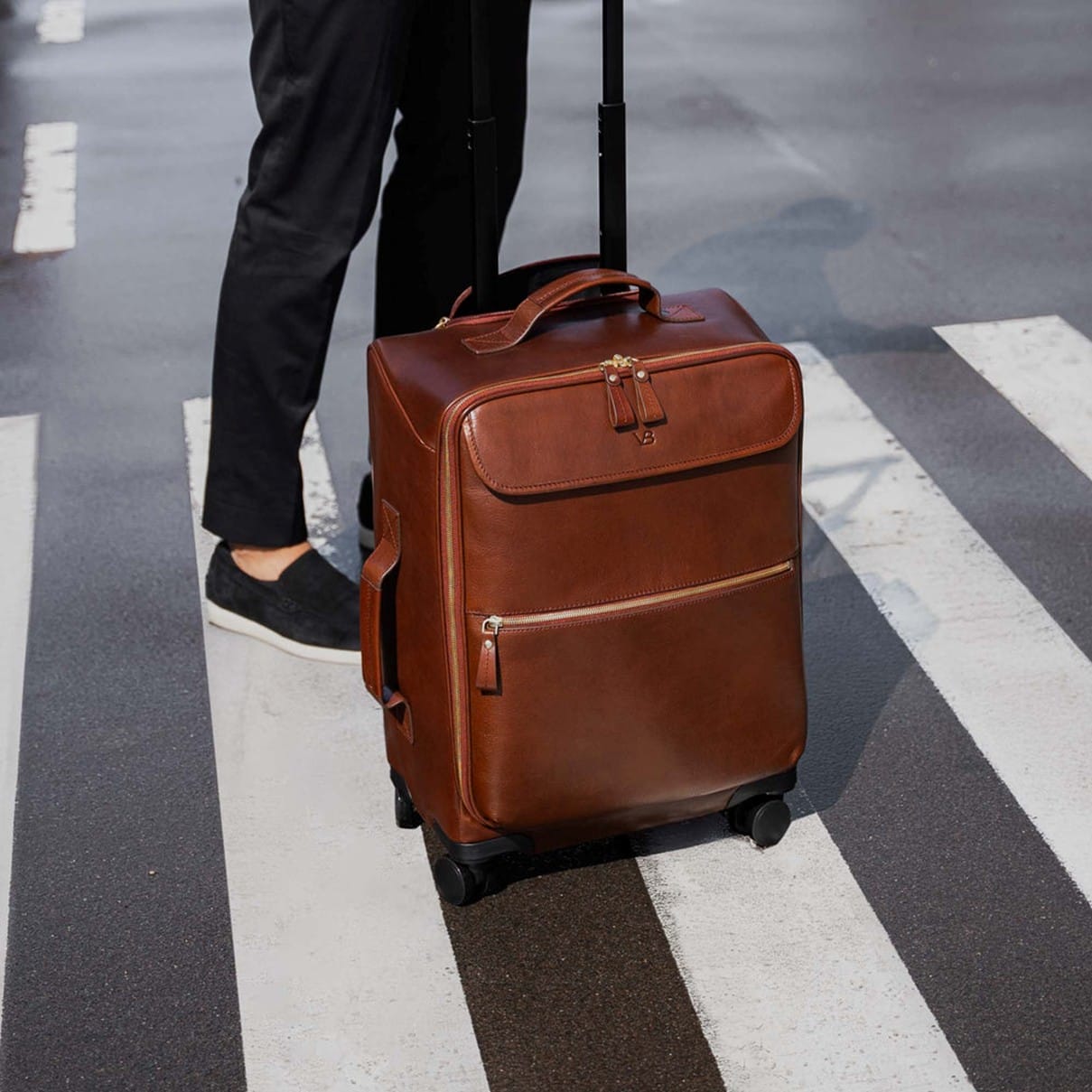
Source: Von Baer
Lines. Overhead bins. Parking garages. Stairwells. A bad bag turns all of that into a wrestling match. The classic failure is asymmetry—one shoulder up, one hip shoved out, one hand clenching. Hold that for 30–60 minutes and your neck and low back will complain. Sustained shoulder elevation beyond about 10 degrees puts significant strain on the trapezius muscles.
Are you optimizing for how the bag carries, or how fast you can access things?
Most people try to get both without realizing they’re trading one off every time.
Carry comfort
Balanced weight that doesn’t yank one shoulder down keeps posture neutral while standing. It works because centered loads reduce lateral spine bend and shoulder elevation. Asymmetrical loads above roughly 10–15% of body weight noticeably increase spinal loading. The mistake is overpacking because “the bag can handle it.” Sure. Your body can’t.
Access comfort
Quick-reach pockets, no full unpacking in tight spaces, zippers that work one-handed. This works because less rummaging means fewer stress spikes, and stress spikes crank muscle tone within seconds. Too many pockets backfire, though. Access comfort only works when every item has a consistent home.
Reality check
If you’re setting the bag on the floor just to grab a charger or ID, you’ve lost. Bending and twisting under load is exactly how back flare-ups start.
Higher-quality bags fail less when you’re tired and rushed. Weak handles, sagging structure, sticky zippers—they always show up at the worst moment. This isn’t about status. It’s about fewer failure points over hundreds of load cycles per trip.
Think in three zones and don’t cheat.
Quick access: phone, ID, keys, glasses, lip balm, tissues—the stuff you touch while standing. Access time ≤3 seconds.
Mid-access: chargers, meds, headphones, snacks—≤10 seconds.
Deep: clothes and extras you don’t touch mid-journey.
Anything you need in a line must be reachable with one hand without opening the main compartment. Shoulder carry means switching shoulders every 10–15 minutes. Rolling means the handle height should land around your wrist crease when standing so your shoulder stays relaxed.
Full-grain leather is the most durable leather option and holds its shape over time. That structure and longevity are real advantages. The tradeoff is weight. On long terminals or stairs, lighter materials often win. Choose based on how much you carry, not how it looks online. Looking for a good brand? Von Baer Travel Bags are good high-quality full-grain vegetable-tanned leather bags, including their Voyager Carry-on and unique Grand Leather Garment Bag.

Source: https://unsplash.com/photos/text-7lyRKyKIdJY
Gate change. Detour. Unclear sign. None of these are disasters. But suddenly they feel personal. That’s cognitive fatigue. Every uncertainty forces a mini planning session under pressure. Heart rate ticks up. Jaw tightens. Shoulders creep toward your ears.
Do you simplify decisions, or force yourself to stay flexible?
Flexibility sounds good. In practice, it’s exhausting in loud, crowded places.
Reduce decisions
Same pocket for essentials every trip. One meal plan. One movement rule. Predictable routines lower cognitive load, keep the nervous system calmer, and make discomfort easier to tolerate. The mistake is over-engineering. You want fewer decisions, not a spreadsheet.
Stay flexible
More improvising, higher mental load. Flexibility at home is empowering. Flexibility in an airport is just more decisions with louder consequences.
How to Cut Decision Fatigue Without Overthinking It
Default pocket mapping—phone always here, ID always there, charger always in that pouch. Searching under pressure spikes heart rate and muscle tone.
Use the two-step navigation rule: you should instantly answer “Where’s my ID?” and “Where are my headphones?” If you can’t, your setup will fail when you’re tired.
Batch decisions. Decide meals and movement triggers before leaving, then execute instead of debate.
Movement triggers that work without thinking: refill water and move for 60 seconds; change podcasts and roll shoulders and ankles; stop the car and stretch hip flexors before doing anything else.
Reality check
If tiny delays make you snappy, your mental bandwidth is gone. Simplify. Don’t push.
That mental load feeds straight into physical stiffness—which brings us to the next trap.
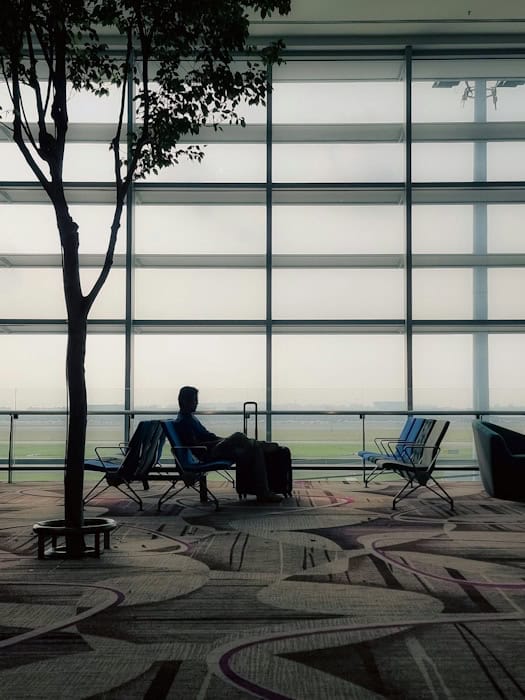
Source: https://unsplash.com/photos/a-man-sitting-in-a-chair-next-to-a-tree-9elwol96Ik8
Most people move when pain forces them to. By then, muscles resist. The difference between people who arrive wrecked and people who don’t is timing.
Do you move on a schedule, or only once discomfort shows up?
Scheduled movement—short, regular breaks—prevents lock-up. It works because joint lubrication drops after about 30–60 minutes static, and movement resets it. The failure is making the plan too ambitious.
Reactive movement feels easier in the moment but costs more later. Once stiffness sets in, the body treats movement like a threat, and those first steps feel sketchy.
In-seat or in-car (30–60 seconds):
Ankle pumps (10–20), ankle circles (10 each way), glute squeezes (10), shoulder blade squeezes (10), pelvic tilts (10).
Standing in line (30–60 seconds):
Calf raises (15–25), weight shifts (10–20), neck yes/no micro-moves (5–10 each).
At a stop (2–5 minutes):
Hip flexor stretch (30 seconds each side, 1–2 rounds), thoracic rotation (5–8 each side), brisk walk (2–3 minutes).
Every 10–15 minutes, micro-shift. Every 60–120 minutes, stand or walk. After long frozen periods, reset as soon as you can.
Reality check
If your first steps feel creaky, you waited too long. That’s feedback. Adjust the timing.
Movement helps—but not if you’re dehydrated.
You’re not thirsty. Still: headache. Swollen feet. Bad sleep. Hydration affects blood volume, circulation, and how sticky muscles feel. Small deficits change how discomfort registers.
Do you drink steadily, or avoid bathrooms and pay for it later?
Drinking steadily supports circulation and reduces stiffness and headaches. It works because steady fluids keep blood moving. Chugging backfires.
Avoiding drinks cuts bathroom trips but increases perceived effort. Everything feels harder.
Start before departure—16–24 oz (475–700 ml) in the 2–3 hours before leaving. Pair fluid with salt and food. Target sodium around 300–600 mg per hour during long travel. Use bathroom breaks as movement breaks. Ideal frequency is every 2–3 hours.
Troubleshooting
If you’re peeing constantly, slow down and add food. If you’re not peeing for hours, you’re behind.
Reality check
Dark urine or restless legs that night means hydration lagged.
Now the trip’s basically over. One last decision decides how tomorrow feels.
There’s no skipping the bill. You pay in transit, or you pay in recovery.
Do you decompress when you arrive, or push through and regret it?
Decompressing—light movement, a shower, simple food, early sleep—works because it tells the nervous system the threat is over. Warm water drops muscle tone. Movement restores circulation. Sleep repairs. Heavy meals backfire, so finish eating at least 2–3 hours before bed.
Pushing through feels productive but just shifts the cost. The body doesn’t bank recovery; it collects debt.
Ten minutes to unpack essentials, drink water, and shower.
Ten minutes for a short walk or gentle mobility.
Light food with 20–30 g protein.
Bed on time.
Reality check
If sleep feels shallow, the journey asked too much. Next time, pull the earlier levers—schedule, movement timing, hydration, bag friction—so decompression isn’t playing catch-up.
Here’s the thing I wish someone had told me years ago: travel discomfort isn’t random. It’s small, early decisions stacking quietly. Fix the order—schedule, seat, bag, friction, movement, hydration—and travel stops feeling like something you survive and starts feeling manageable. Maybe even easy.

Sara Essop is a travel blogger and writer based in South Africa. She writes about family travel and experiences around the world on her blog "In Africa and Beyond". Although she has been to 53 countries thus far, she especially loves showcasing her beautiful country and is a certified South Africa Specialist.